

xduwq.over-blog.com/
10 Janvier 2021

CodeKit lets you compile everything: Less, Sass, Stylus, CoffeeScript, Typescript, Jade, Haml, Slim, Markdown & Javascript. Refresh browsers across devices.
CodeKit is a web development tool for Mac, written by Bryan Jones (follow him on Twitter here). At it's most basic level, it runs 'behind the scenes' of your usual IDE (I use the excellent Coda). It compiles LESS, SASS, Stylus and other code files as you work – it provides error checking and minification for CSS and Javascript amongst others.
It's been around for a few months – still in Beta stage, but from what I can see, pretty much ready to go.
It basically allows you to develop your sites using LESS (or one of the others) without the need to load the LESS dependency (a small Javascript file which normally does the compiling for you when you load the site).
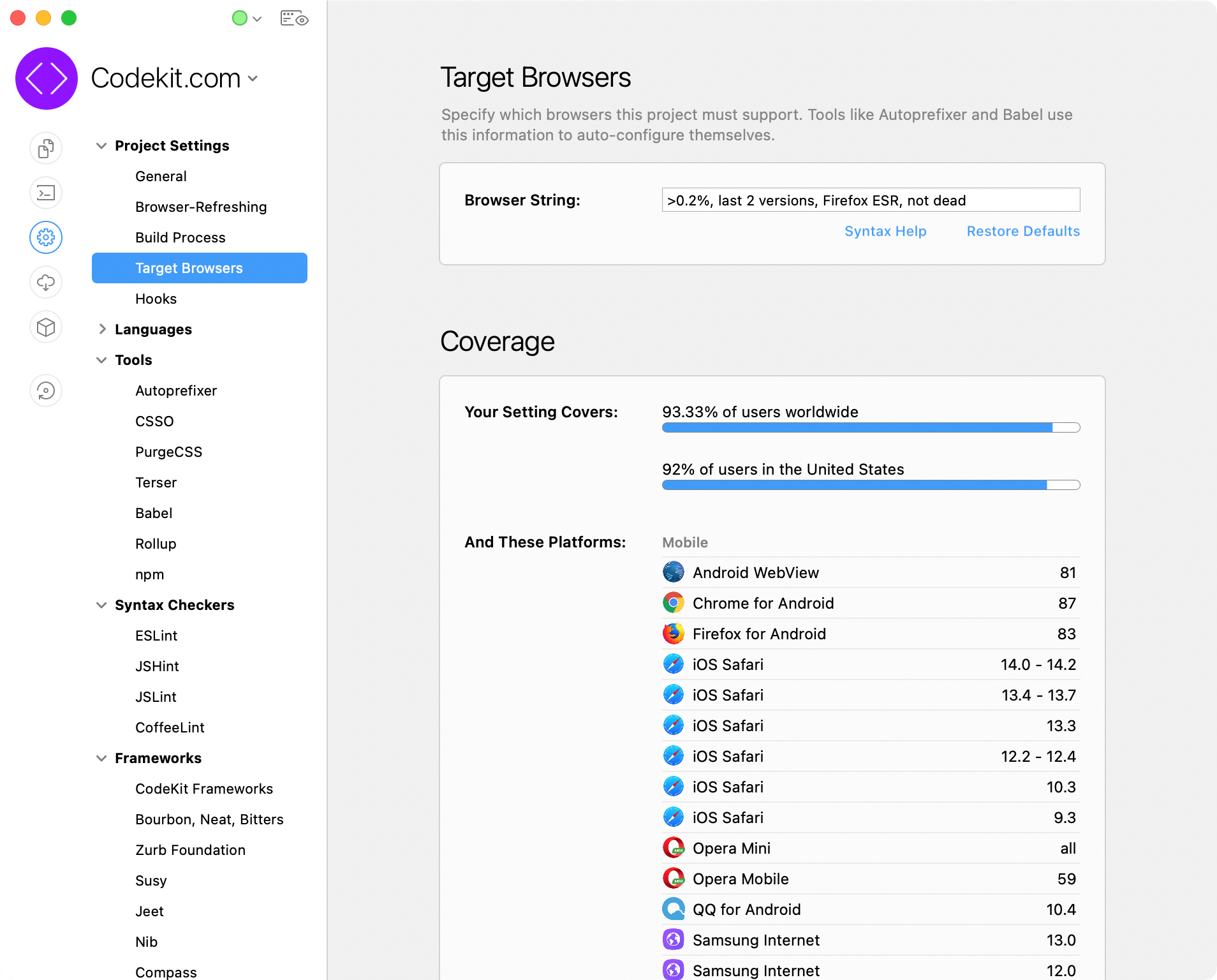
It's smart. Really smart. I would suggest you check out the website and Bryan's excellent videos to get a better grasp of what it can do for your workflow.
LESS is described as 'the dynamic stylesheet language'. I'm not fluent with LESS yet, I hadn't dived-in with everyone else partly because I've been busy of late, and partly because I was hesitant due to it's apparent reliance on Javascript to work correctly.
LESS allows you to use Javascript-style variables and functions within your CSS, and to construct CSS in a way that's far more structured and manageable in the future. The logic is pretty simple and easy to get to grips with. Go check out the LESS website now for more information and code examples.
Here's what you will need in order to work directly on your live server/website with CodeKit:
CodeKit will recognise the changes you make as you save the files. You may need to wait a few seconds longer for the data to be transferred (compared to working locally, which is instant), but it works perfectly.
State of mind 1 1. I had some issues with this method today – at first I thought it might be a combination of attempting to use a local CodeKit framework with imports into the remote LESS file, however it turned out to be because I was editing the remote files via FTP.
For some reason, CodeKit does not recognise these edits, and the file (no matter how many times you save, or refresh the project in CodeKit) will stay as it is. Looking at the folder structure, there are some hidden files generated by CodeKit which could be to blame (cache files perhaps?).
Anyway, the workaround is to simply edit the files as if you were working locally, so just drag the mounted files/structure (how you do this depends on the IDE of course) into your IDE and edit then as if they were local files. CodeKit then recognises the changes and works as normal, including importing any framework files you're referenced.
Oh, and if you use Coda, I also found a useful syntax highlight mode for LESS, which you can download here:
So, after trying remotely working like this on a bigger project, I soon hit some problems – disconnection errors, FTP limitations, that sort of thing. If these occur mid-save, that can help you lose some data, which is never a good thing.
It's worth pointing out that these problems are not the fault of CodeKit; just limitations with server hardware, setup and that sort of thing.
I didn't want to move the development work locally (it makes it too hard for things like client approvals), so looked into other ways of working remotely, and Dropbox provided the answer.
You'll need an account with Dropbox of course (sign up with my affiliate ref and get an extra 250Mb here), as we'll be using it's Public Folder feature to store our compiled CSS.
That's pretty much it. When you edit and save any of your imported LESS files, CodeKit will compile the CSS, save it to Dropbox, and Dropbox will instantly update the online version. Due to the generally small size of CSS files, this should only take a couple of seconds and you'll be able to refresh and see your changes.
LESS makes it easy to fix any path issues – obviously unless you save all of your images within your Dropbox public folder, they won't show up because the path will be incorrect.
To fix this, set a less variable for your site's Base URL:
Then, simply reference this variable every time you want to use an image in your CSS:
…and you'll be good to go!
Glad to see someone has gotten Transmit's mount feature to work with CodeKit! Another way to do this is to use MacFuse to mount the remote server as a disk. Some people who had trouble getting Transmit to work reported success with MacFuse.
The reason CodeKit can't detect changes on a remote server (unless you mount it as a virtual disk) is that the app relies on the OS X kernel to tell it when files change. If those files are on a remote server, the kernel doesn't handle reading/writing them, so it doesn't detect changes. (The read/writes are handled by the operating system on your server, not your local machine.)
And finally, CodeKit creates *zero* hidden files in your project. I would be super pissed if I downloaded an app that junked up my projects with hidden garbage, so I will never write an app that behaves that way. These hidden files may be a byproduct of mounting a remote folder as a virtual disk or there may be something else going on. Either way, CodeKit doesn't create them!
Thanks for the tips!
Thanks for sharing all of that, I'm loving CodeKit at the moment but I'm still not happy with not having a decent method to use it beyond initial development kick off stages.
Was curious to know if you've stuck with your dropbox method and are still using CodeKit or if you've moved onto something new?
[…] to experiment with a couple articles that were mainly geared towards CodeKit. I found an article, Working Remotely with CodeKit & LESS, and used that to figure out how to get it working for me with Coda and […]
OMG you are brilliant. I have been having issue with developing remotely and I never thought about using dropbox. I could kiss you. (no homo)
now I just need to figure out how to do the variable url path for scss
scratch that. Here it is.
$assetPath: 'path/';
div{
background:url(#{$assetPath}image.png);
}
@matthew carleton: Is that plain Sass? If you are using Compass, you have the image-url function for this. http://compass-style.org/reference/compass/helpers/urls/
@Per Wiklander: that is scss. But I am not into compass yet. Workin on it. Thanks for the tip!
Thanks for sharing.
This method works for me perfectly, well a bit slow waiting for the CodeKit to update (15-20 sec) all the files in my folder but it works fine.
Hopefully CodeKit will have the feature later.
@Dan – Like you, I work a lot on remote servers, using Coda, and wanted to find some incorporating compiled LESS into that work-flow. I have found some success in a sort of mash-up of your attempts.
I don't use Dropbox, but depend, as you first did, on Transmit to mount the remote site folder locally.
Then I create (or copy-and-rename the css file) the LESS file, but just to a simple local folder.
Now, I drop the local LESS file into CodeKit, setting the locally-mounted, remote site CSS folder/file as the destination after compilation.
Finally, I edit the local LESS file in Coda as usual. Saving the file triggers CodeKit (easy, as they're both on my local machine), which then compiles and loads the updated CSS file into the remote site folder, mounted locally by Transmit.
I've found that this doesn't always (or even, often) trigger Safari to update the page view, but then I'm used to working like this in Coda – I rarely use its preview function, preferring the time-honoured solution of hitting refresh on an external browser!
Any FTP errors or time-outs (I haven't experienced any so far) would merely mean that the compilation would not get transferred to the remote folder. That could easily be fixed by compiling again in CodeKit.
@Bryan – The only thing I'm not 100% happy about in this method is that I don't have a remote copy of the LESS file, in case I ever need to modify the site CSS from another machine or location. It would be great if somehow CodeKit could have an option to also upload the LESS file along with the compiled CSS.
In the meantime, I'm pretty happy … and a big +1 of thanks to Bryan for CodeKit.
Best regards
Mike Laye
Does anyone have any recommendations for a windows equivalent of code kit?
I'm looking for something that offers style injection, sass/compass support, and minification. JSHint and frameworks would be nice to have also. Anything on top of that would just be a bonus.
I already tried mixture.io but couldn't get style injection to work. Jixipix hallows eve 1 13 kjv.
Thanks in advance!
Have you tried Prepros?
I like Compass.app much better than Prepos on Windows. Whenever I used Prepos my computer would lag out. Fotomagico pro 5 5 download free.
@chrisburton, I'm surprised. I used to be a big fan of Compass.app, but after I tried Prepros, I decided it worked just as great, if not better. Definitely no lag issues there.
Have not actually tried the live-reload functionality, though…just the pre-processing parts.
It could have just been my computer. Glad I got rid of it and switched to a Macbook Pro.
I was all rooting for you until…
Glad I got rid of it and switched to a Macbook Pro.
;)
I'm using Windows too and have been looking for a Windows equivalent to CodeKit. This forum has really helped me. I think I'll give Prepos a try.
Glad I got rid of it and switched to a Macbook Pro.
Good Mac users are just linux users who haven't found the courage to grow out their beards yet
I reported the lag issue soon after the author published a post about it here in the forum. Maybe he fixed it?
As an alternative more configurable option, you can run Grunt or Gulp on Windows and either will do what Codekit does but both require a lot more configuration. Check them out, task runners are amazing! Think all the automation of Codekit and a lot more!


/image%2F6303077%2F20210327%2Fob_60d6b0_firefox-72-0-1.jpeg)
/image%2F6303077%2F20210327%2Fob_42bf7d_macos-server-5-9-32.jpeg)
/image%2F6303077%2F20210218%2Fob_3aa869_editrocket-4-5-0-download-free.png)
/image%2F6303077%2F20210218%2Fob_39a270_pacifist-3-6-2.jpeg)